

- University
- Academic
- Schools/Vocational Schools
- Vocational School of Justice
- Vocational School
- Vocational School
- Department of Banking and Insurance (Turkish)
- Department of Computer Programming (Turkish)
- Department of Foreign Trade (Turkish)
- Department of Graphic Design (Turkish)
- Department of Interior Design (Turkish)
- Department of Construction Technology (Turkish)
- Department of Occupational Health and Safety (Turkish)
- Department of Media and Communication (Turkish)
- Department of Architectural Restoration (Turkish)
- Department of Radio and Tv Programming (Turkish)
- Department of Civil Aviation Cabin Services (Turkish)
- Department of Civil Aviation Transportation Management (Turkish)
- Department of Tourism and Hotel Management (Turkish)
- Department of Applied English Translation
- Vocational School Of Health Services
- Vocational School Of Health Services
- Department of Child Development (Turkish)
- Department of Physiotherapy (Turkish)
- Department of Paramedic (Turkish)
- Department of Opticianry (Turkish)
- Department of Medical Documentation and Secreteriat (Turkish)
- Department of Medical Imaging Techniques (Turkish)
- Department of Medical Laboratory Techniques (Turkish)
- Department of Elderly Care (Turkish)
- School of Applied Management Sciences
- School of Foreign Languages
- Faculties
- Faculty of Arts and Sciences
- Faculty of Fine Arts and Design
- Faculty of Law
- Faculty of Communication
- Faculty of Business
- Faculty of Engineering
- Faculty of Engineering
- Department of Computer Engineering
- Department of Biomedical Engineering
- Department of Electrical and Electronics Engineering
- Department of Industrial Engineering
- Department of Food Engineering
- Department of Genetics and Bioengineering
- Department of Aerospace Engineering
- Department of Civil Engineering
- Department of Mechanical Engineering
- Department of Mechatronics Engineering
- Department of Software Engineering
- Faculty of Health Sciences
- Medicine
- Graduate School
- Common Courses
- Schools/Vocational Schools
- Research
- Research Centers
- Library
- Smart Campus
- Technology Transfer Office
- İzmir Sciencepark
- Continuous Education Center (EKOSEM)
- Children's University
- Ethics Committee
- Teaching and Learning Center (EKOEĞİTİM)
- Psychology Application and Research Center
- Researcher Training Coordinatorship
- Research Collaborations And Innovation Coordinatorship
- Campus
- INTERNATIONAL
- Contact
- 25TH YEAR
Department of Nutrition and Dietetics
BES 204 | Course Introduction and Application Information
| Course Name |
Food Microbiology and Food Safety
|
|
Code
|
Semester
|
Theory
(hour/week) |
Application/Lab
(hour/week) |
Local Credits
|
ECTS
|
|
BES 204
|
Spring
|
2
|
2
|
3
|
5
|
| Prerequisites |
None
|
|||||
| Course Language |
Turkish
|
|||||
| Course Type |
Required
|
|||||
| Course Level |
First Cycle
|
|||||
| Mode of Delivery | - | |||||
| Teaching Methods and Techniques of the Course | DiscussionQ&AApplication: Experiment / Laboratory / WorkshopLecture / Presentation | |||||
| National Occupation Classification | - | |||||
| Course Coordinator | ||||||
| Course Lecturer(s) | ||||||
| Assistant(s) | ||||||
| Course Objectives | The aim of this course is for students to learn the fundamental concepts of food microbiology and safety and to understand the subject in detail through relevant laboratory applications. |
| Learning Outcomes |
The students who succeeded in this course;
|
| Course Description | The topics covered include the survival and death of microorganisms, biosecurity, spoilage in meat, poultry and seafood, spoilage in milk and dairy products, spoilage in vegetables and fruits, spoilage in nuts and grains, foodborne pathogenic bacteria, foodborne viral pathogens and prions, food and waterborne parasites, toxigenic fungi, epidemiology of foodborne diseases, and advanced techniques in food microbiology. |
| Related Sustainable Development Goals |
|
|
|
Core Courses |
X
|
| Major Area Courses | ||
| Supportive Courses | ||
| Media and Management Skills Courses | ||
| Transferable Skill Courses |
WEEKLY SUBJECTS AND RELATED PREPARATION STUDIES
| Week | Subjects | Related Preparation |
| 1 | Introduction to food microbiology, basic concepts. Application: Introduction to the laboratory, biosafety and aseptic working rules. | Chapter 1 – History and Scope of Food Microbiology, s. 1–18 (Jay et al., 2005). |
| 2 | Classification of microorganisms and their relationship with food. Application: Microscope use, basic staining techniques. | Chapter 2 – Microorganisms Relevant to Foods, s. 19–45 (Jay et al., 2005). |
| 3 | Factors affecting the growth of microorganisms. Application: The effect of pH, temperature, and water activity on microbial growth (demonstration) | Chapter 3 – Factors Affecting Growth of Microorganisms in Foods, s. 47–85 (Jay et al., 2005). |
| 4 | Survival and death mechanisms of microorganisms. Application: The effect of heat treatment and disinfectants on microorganisms. | Chapter 4 – Microbial Death and Survival, s. 87–120 (Jay et al., 2005). |
| 5 | Microbial spoilage in food – general principles Application: Microbiological evaluation of spoiled food samples (observational) | Chapter 6 – Microbial Spoilage of Foods, s. 147–190 (Jay et al., 2005). |
| 6 | Microbial spoilage in meat, poultry, and seafood. Application: Total live count in meat products (demonstration). | Chapter 7 – Microbiology of Meat, Poultry, and Seafood, s. 191–230 (Jay et al., 2005). |
| 7 | Microbial spoilage in milk and dairy products. Application: Hygiene indicators in dairy products. | Chapter 8 – Microbiology of Milk and Dairy Products, s. 231–270 (Jay et al., 2005). |
| 8 | MIDTERM EXAM | |
| 9 | Microbial spoilage in vegetables, fruits, grains, and nuts. Application: Examples of surface contamination and cross-contamination. | Chapter 9 – Microbiology of Vegetables, Fruits, and Cereals, s. 271–310 (Jay et al., 2005). |
| 10 | Foodborne bacterial pathogens. Application: Introduction into selective media and colony evaluation. | Chapter 25 – Foodborne Bacterial Pathogens, s. 675–740 (Jay et al., 2005). |
| 11 | Foodborne viral pathogens and prions. Application: Indirect assessment of viral contamination (case-based). | Chapter 26 – Foodborne Viruses and Prions, s. 741–770 (Jay et al., 2005). |
| 12 | Food and waterborne parasites. Application: Assessment of parasitic risks in the food chain. | Chapter 27 – Foodborne Parasites, s. 771–800 (Jay et al., 2005). |
| 13 | Toxigenic molds and mycotoxins. Application: Examples of mold growth and mycotoxin risk. | Chapter 29 – Mycotoxins, s. 825–860 (Jay et al., 2005). |
| 14 | Introduction to food safety, hygiene, sanitation, and HACCP. Application: Identifying HACCP critical control points for a sample kitchen/facility. | Chapter 33 – Food Protection and Sanitation, s. 935–980 (Jay et al., 2005). |
| 15 | Epidemiology of foodborne illnesses and case examples. Application: Evaluation of clinical and mass feeding cases along with laboratory results. | Chapter 30 – Epidemiology of Foodborne Diseases, s. 861–900 (Jay et al., 2005). |
| 16 | FINAL EXAM |
| Course Notes/Textbooks | Jay, J.M., Loessner, M.J., Golden, D.A. 2005. Modern Food Microbiology (7th ed.). Springer, NY. |
| Suggested Readings/Materials |
EVALUATION SYSTEM
| Semester Activities | Number | Weigthing |
| Participation |
1
|
5
|
| Laboratory / Application |
1
|
25
|
| Field Work | ||
| Quizzes / Studio Critiques | ||
| Portfolio | ||
| Homework / Assignments |
1
|
10
|
| Presentation / Jury |
1
|
10
|
| Project | ||
| Seminar / Workshop | ||
| Oral Exams | ||
| Midterm |
1
|
20
|
| Final Exam |
1
|
30
|
| Total |
| Weighting of Semester Activities on the Final Grade |
5
|
70
|
| Weighting of End-of-Semester Activities on the Final Grade |
1
|
30
|
| Total |
ECTS / WORKLOAD TABLE
| Semester Activities | Number | Duration (Hours) | Workload |
|---|---|---|---|
| Theoretical Course Hours (Including exam week: 16 x total hours) |
16
|
2
|
32
|
| Laboratory / Application Hours |
16
|
2
|
32
|
| Study Hours Out of Class |
14
|
2
|
28
|
| Field Work |
0
|
||
| Quizzes / Studio Critiques |
0
|
||
| Portfolio |
0
|
||
| Homework / Assignments |
1
|
12
|
12
|
| Presentation / Jury |
1
|
6
|
6
|
| Project |
0
|
||
| Seminar / Workshop |
0
|
||
| Oral Exam |
0
|
||
| Midterms |
1
|
10
|
10
|
| Final Exam |
1
|
15
|
15
|
| Total |
135
|
COURSE LEARNING OUTCOMES AND PROGRAM QUALIFICATIONS RELATIONSHIP
|
#
|
Program Competencies/Outcomes |
* Contribution Level
|
|||||
|
1
|
2
|
3
|
4
|
5
|
|||
| 1 |
Effectively uses evidence-based professional knowledge of basic, health and social sciences required by the dietitian profession throughout their professional life. |
X
|
-
|
-
|
-
|
-
|
|
| 2 |
Gains the ability to use the acquired knowledge to improve the health level and quality of life of the society. |
-
|
X
|
-
|
-
|
-
|
|
| 3 |
Gains the ability to work effectively as an individual and to take responsibility in multidisciplinary teamwork. |
-
|
-
|
-
|
-
|
-
|
|
| 4 |
Identifies, defines, interprets, decides and solves the problems that may be encountered in different fields of Nutrition and Dietetics. |
-
|
-
|
X
|
-
|
-
|
|
| 5 |
Applies individual-specific professional knowledge in accordance with the physiological, environmental and socio-cultural needs of healthy and/or sick individuals. |
-
|
-
|
-
|
-
|
-
|
|
| 6 |
Continuously improve themselves in their field by using accurate and reliable information and modern information technologies. |
X
|
-
|
-
|
-
|
-
|
|
| 7 |
Acquires the ability to communicate verbally and in writing at national and international level on professional issues related to the field of Nutrition and Dietetics. |
-
|
X
|
-
|
-
|
-
|
|
| 8 |
Acts in accordance with social, scientific and ethical values in the stages of data collection, interpretation and evaluation of results while conducting research in the field of Nutrition and Dietetics. |
-
|
-
|
-
|
-
|
-
|
|
| 9 |
Acquires knowledge and practical skills in the development of individual and social nutrition recommendations at national and international level, and the establishment of food and nutrition plans and policies. |
-
|
X
|
-
|
-
|
-
|
|
| 10 |
Acts in accordance with the awareness of professional ethics within the legal framework related to their duties, rights and responsibilities. Sets an example to colleagues and society. |
-
|
-
|
-
|
-
|
-
|
|
*1 Lowest, 2 Low, 3 Average, 4 High, 5 Highest
NEWSALL NEWS



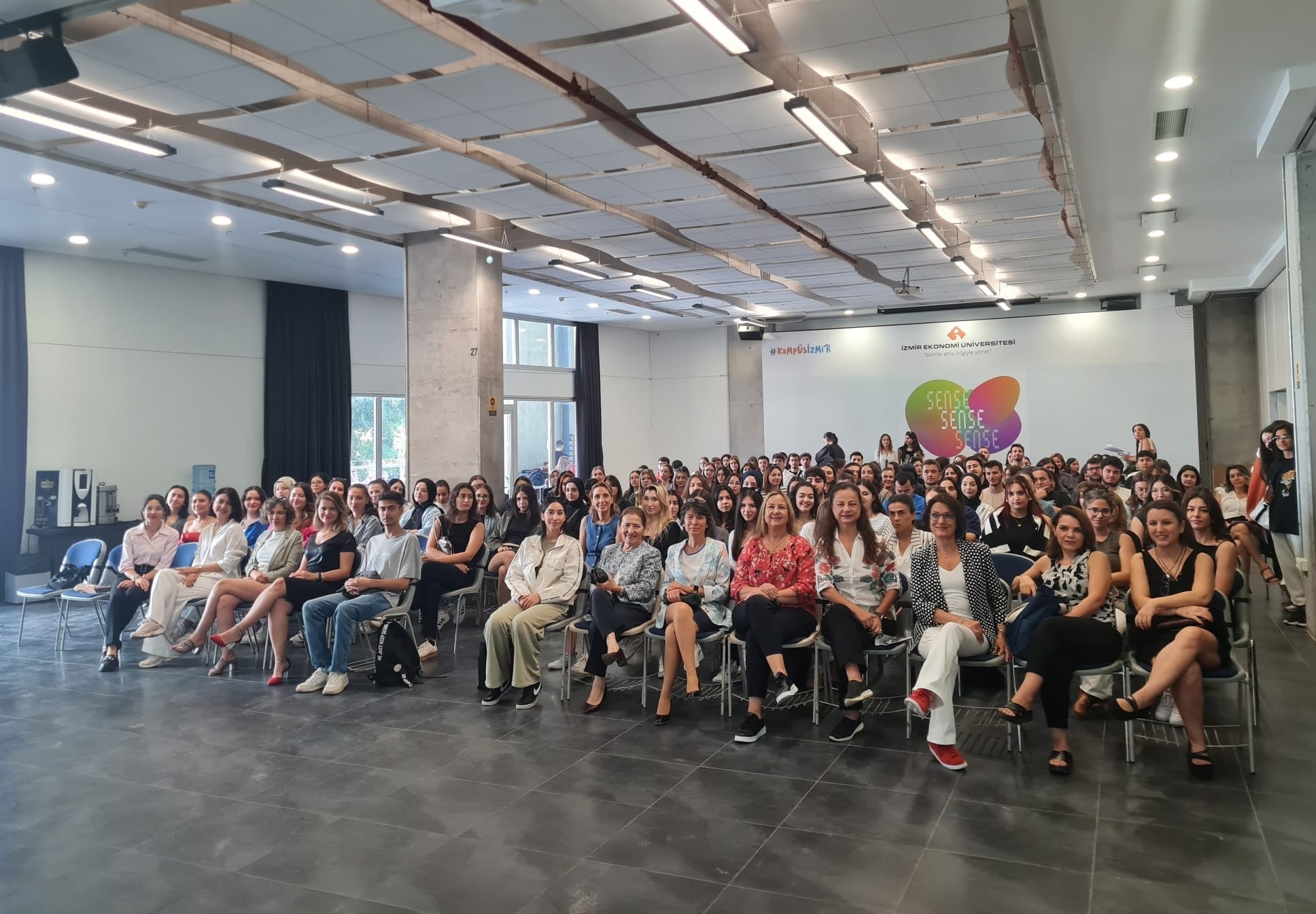

IZMIR UNIVERSITY OF ECONOMICS GÜZELBAHÇE CAMPUS
DetailsGLOBAL CAREER
As Izmir University of Economics transforms into a world-class university, it also raises successful young people with global competence.
More..CONTRIBUTION TO SCIENCE
Izmir University of Economics produces qualified knowledge and competent technologies.
More..VALUING PEOPLE
Izmir University of Economics sees producing social benefit as its reason for existence.
More..
You are one step ahead with your graduate education at Izmir University of Economics.